In Critical Thinking it is important to always understand what you are reading.
This may sound obvious but there are times when one can read some thing but not fully understand its meaning. You must be able to understand the writer view point, what are they assuming, what do they want the readers to believe after they have read there work. Once you understand where the writer is coming from and what their focus is you can go on to form your own opinions and ideas.
Now you can use critically thinking to look at all different aspects of the writing because you have first seen it in all angles.
Wednesday, July 7, 2010

Tuesday, June 29, 2010
Chapter 7 : Evaluations: What's Judged // Inference to Identify Implied Main Ideas
Chapter 7 : Inference to Identify Implied Main Ideas

Evaluations What's Judged:
Evaluations make judgments about worth on the basis of standards that may be conscious or unconscious. It can help us react quickly to situation where our survival is a stake. Evaluations are not facts. Factual reports keep the distinction between facts and evaluations clear.
Propaganda employs many sophisticated manipulative techniques of persuasion. One of these is the use of hidden evaluations. A critical thinker knows how to recognize and detach from the influence of propaganda.
Connotative words convey evaluations that can be used to sway our opinions. When we think critical.

Evaluations What's Judged:
Evaluations make judgments about worth on the basis of standards that may be conscious or unconscious. It can help us react quickly to situation where our survival is a stake. Evaluations are not facts. Factual reports keep the distinction between facts and evaluations clear.
Propaganda employs many sophisticated manipulative techniques of persuasion. One of these is the use of hidden evaluations. A critical thinker knows how to recognize and detach from the influence of propaganda.
Connotative words convey evaluations that can be used to sway our opinions. When we think critical.
Chapter 6: Finding Supporting Details

It is very important to locate the main idea and the major supporting details in a reading assignment are the foundation of college reading. the authors use details to help reads understand the supporting details. As privacy stated, major supporting details provide support for the main idea of a reading. They are commonly presented in the form of examples illustrations, explanations, definitions, facts of opinions. they typically answer who, what, when, how, and why? Minor supporting details are intended to clarify and enhance the major supporting details and are not usually considered as important, However some of them are significant and useful It is important to prioritize details.
Once you identify the main ideas of on your reading material, you can divide the rest of the material into two categories major and main supporting details. If you are able to distinguish between the major and main supporting details, in you reading materials, it means oh have understood what you have reading.
Wednesday, June 23, 2010
Chapter 5: Assumption
Chapter 5 Assumption
Assumption is a pre-existing belief. Part of your belief system. Something you don't question. Your mind takes for granted that your assumption is true.
For Example
1)It would be wise to assume that the lady walking the streets of the Tenderloin at night should be unsafe.
2)If I walk toward you with my hand out and smiling, you'll probably infer that I intend to shake your hand.
Assumptions may also sprout from experiences such as, every time I walk passed by my neighbors' house their dog barks, so from then on I know when I go passed their front yard I am going to hear a barking dog.
Assumption and Inference are deeply intertwined: our assumptions come from our belief and our inference comes from our assumptions. This is the basics of how human nature comes up with logical reasoning.
Your assumption of my intent is based on similar experiences from your past.
Those past events formed your belief about such situations.
Assumption is a pre-existing belief. Part of your belief system. Something you don't question. Your mind takes for granted that your assumption is true.
For Example
1)It would be wise to assume that the lady walking the streets of the Tenderloin at night should be unsafe.
2)If I walk toward you with my hand out and smiling, you'll probably infer that I intend to shake your hand.
Assumptions may also sprout from experiences such as, every time I walk passed by my neighbors' house their dog barks, so from then on I know when I go passed their front yard I am going to hear a barking dog.
Assumption and Inference are deeply intertwined: our assumptions come from our belief and our inference comes from our assumptions. This is the basics of how human nature comes up with logical reasoning.
Your assumption of my intent is based on similar experiences from your past.
Those past events formed your belief about such situations.
Chapter4 : Managing your reading time

Chapter4.
Time is not the only criteria used in judging reading efficiency in college. It is not even the most important one. Efficient reading can be defined as being able to read and comprehend textbook material in an appropriate amount of time for you.
Deciding what an appropriate amount of time is for you depends on many factors. It is related to how much time you actually have available to read for each course, the level of difficulty of the textbook material, and the grade you want to earn in a course.
How to manage your reading is more important than learning how to read rapidly. Always make comprehension your primary goal: reading efficiently the first time through is often faster. If you make speed your priority, you may finish more quickly, but understand less. As a result, you may have to reread material before a test in order to understand and remember it, which is time-consuming.
Track your reading rates so you can create daily reading plans that set realistic goals for your classes each week. After using a study schedule and daily reading plans for several weeks, you will find that you begin to complete your reading assignments on time. Your reading comprehension will also improve, and you may even read a little faster. The reading tips suggested in this chapter that will contribute to your becoming a more efficient reader are: reading quickly when appropriate, skimming, regressing or rereading, sub vocalizing, pacing.
Tuesday, June 22, 2010
Chapter 4 : Inference
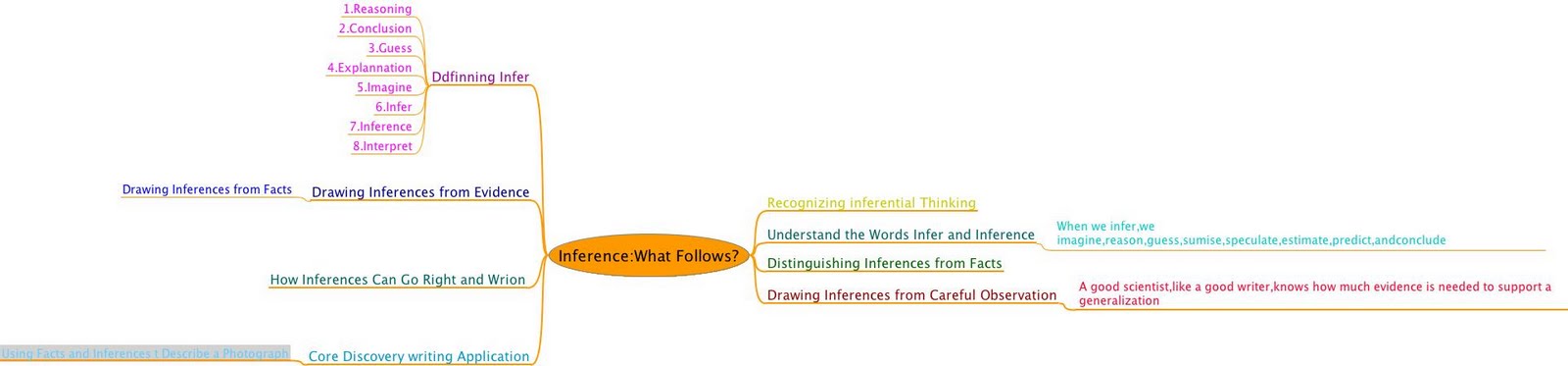
Chapter 4 Inference
Inference thinking is natural to humans, if someone walks up to us with a gun in their hand we are going to assume they mean us harm. Inference is a way of gathering information, due to other things that may give to the ultimate finding. It is important to remember that inference is not factual. Just because one may infer something is going to happen, it may not happen at all, the exact opposite might happen.
Chapter 3: Memory

Memory
In Memory, our brain works as storage information so that you can recall information. Sensory memory is the storage of information which requires 5 senses in order for the brain to work. Through observation messages are being transmitted to the brain which is able to start recalling the events or happenings within our surroundings.
Short term memory is the ability for our brain to only recall information for a short period of time. Chunking is useful for short term memory because it forces the brain to remember groups of things instead of individual element to make the information easier to recall.
Long term memory is the ability for our brain to recall information for a long period of time. information can't be stored in long term memory if it hasn't gone through sensory and short term memory. Rote learning is the action of memorizing thing without understanding and doesn't help to store information in long term memory. Matrix on the other hand helps you recall information by understanding the data.
Subscribe to:
Posts (Atom)